Geographically, much of the Western Highlands of Scotland are closer to Ireland than to the Lowlands. As transportation by boat was much easier than travel overland, Northern Ireland would have been comparatively accessible to the West Highlands, and vice versa. While we now see the countries "Northern Ireland" and "Scotland" no such national entities existed until relatively recent times.
Scottish clans in Ireland.
For centuries they were both divided into clan and tribal holdings. Frequently a clan would have property and clanspeople in both. One such example is a branch of Clan Donald known as "Clan Donald of Dunnyveg and the Glens". "Dunnyveg" refers to a castle in the Hebrides while "the Glens" is in Northern Ireland. The lineage of clans in Scotland and and tribes in Ireland show common ancestors. For instance, O'Neill, MacNeil, MacLachlan, MacSweeney and Lamont all descend from King Aodh, King of Ailech (a medieval kingdom in present-day Donegal), c. 1030.
Highland clans descended from Irish kindreds.
Many of Scottish Highland clans descended from the original three kindreds that migrated to Argyll in the fifth century. From one kindred, Cenel Loairn, descended Clans MacMillan, MacKinnon, MacQuarrie, MacPherson, MacCoul, MacCullough, MacLellan, MacNabb, MacNiven, MacPhee and MacGregor among others. All of these listed clans' progenitors also descended from Scotland's King MacBeth (1040 - 1067AD).

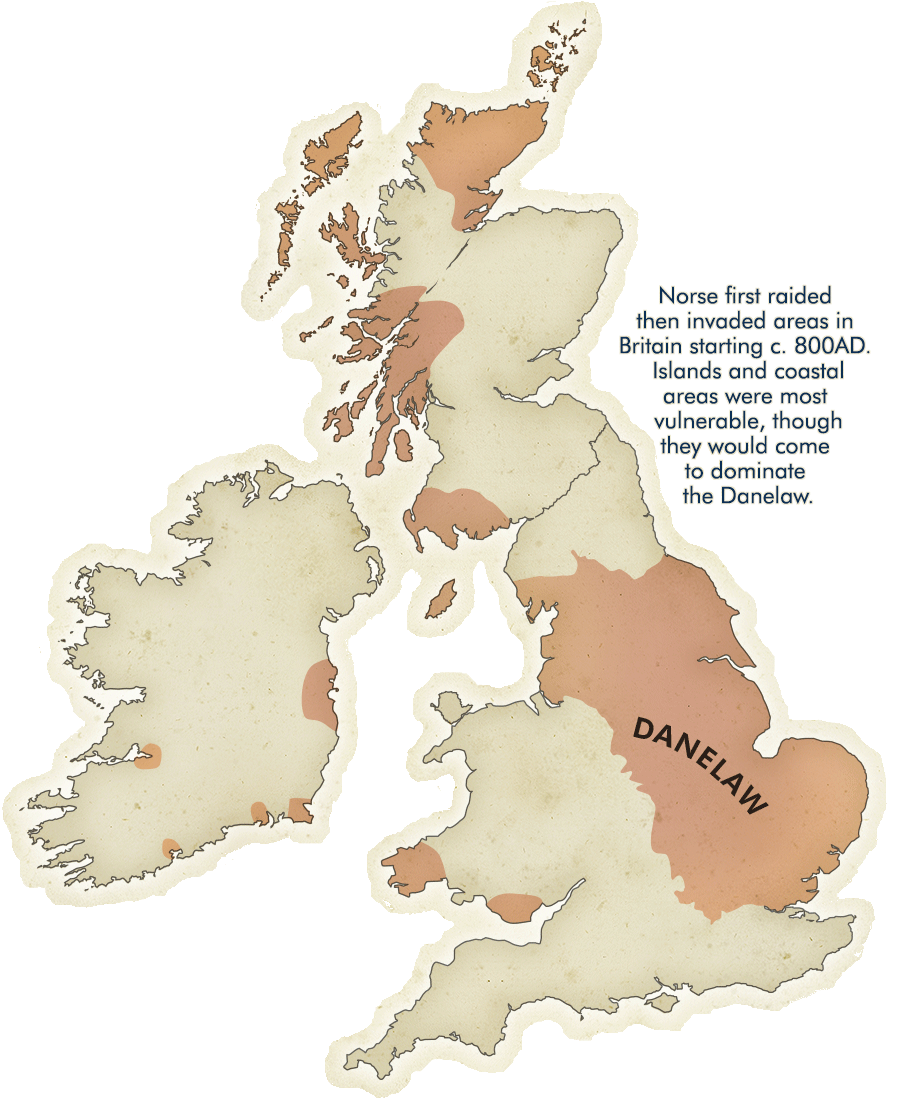


Celts, Norse, Anglo-Saxons and Normans.
Romans, Anglo-Saxons, Norse and Normans invaded the British Isles in turn, as represented in the graphics above. Excepting the Romans, these subsequent invasions were each to make their contribution to the gene pool. Ancestry.com has been tracking millions of DNA submissions from the British Isles. They found Scotland in general has the following ethnic make-up: Celtic 43.84%, Anglo-Saxon 26.18%, Western Europe 13.05%, Scandinavian 7.19% with much smaller amounts of other European ethnicities. The nomenclature is somewhat confusing as Ancestry.com uses "Irish" representing Celts and "British" as Anglo-Saxons. An online article addresses Ireland's ancestry DNA.
In Ireland, these incursions produced little lasting effect outside "The Pale" (Dublin and environs) until the "Plantation" of Ulster in the 17th century. Read more about the Ulster Scots on our Scots-Irish page.